Caucasian Beetle VS Atlas Beetle VS Moellenkampi Beetle
 |
.jpg) |
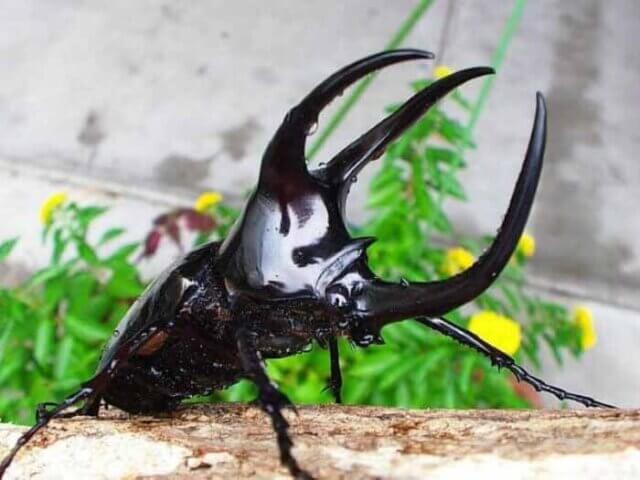
This insect's name is Caucasian beetle. It is my most favorite insect. He has three horns but not enough weight to beat other beetles. But why I like it is because of its cool shape and color. This metallic green and this shape that looks like a cross between a Stag Beetle and Hercules tickles my fancy. However, there are similar species of Caucasian beetles which are called Molenkampi beetle and Atlas beetle. This time, I'll introduce, the differences between them


Caucasian Beetle Moellenkampi Beetle Atlas Beetle
They are difficult to identify by the upper horns, but the shape of the lower jaw horns can assist in judging the type. They have a glossy sheen, but it is a different color. It is green in Caucasus, brown in Atlas and red in Moellenkampi. Then while one of their commonalities is that they live on peninsulas and islands, they have a very aggressive nature and live in an area of high elevation on mountains.
So far, the only difference among the three types exists in shape. However, Caucasians Beetles have the largest maximum body size but they are the weakest of the three because they are temperature-sensitive. While there is not much difference between these, we can see that the Caucasians Beetle is the weakest at adapting to environmental changes.So, which insects are the strongest in terms of strength?
This video, shows the result. ↓
The Atlas beetle is the strongest of the three insects.
In general, Caucasus is the most powerful, while Atlas and Mollenkamp are same strength because they are the largest of the three but as I wrote before, they are vulnerable to environmental changes and their growth is also dependent on the environment. And Atlas beetles grow well regardless of the environment which is why this result was obtained.
While they are similar in habitat area, character, and shape, I could not find out why they are different species. If I will find out it, I would like to post into this topic more deeply again.
Reference
Wikipedia

Comments
Post a Comment